
Hannah Robinson
Staff Writer
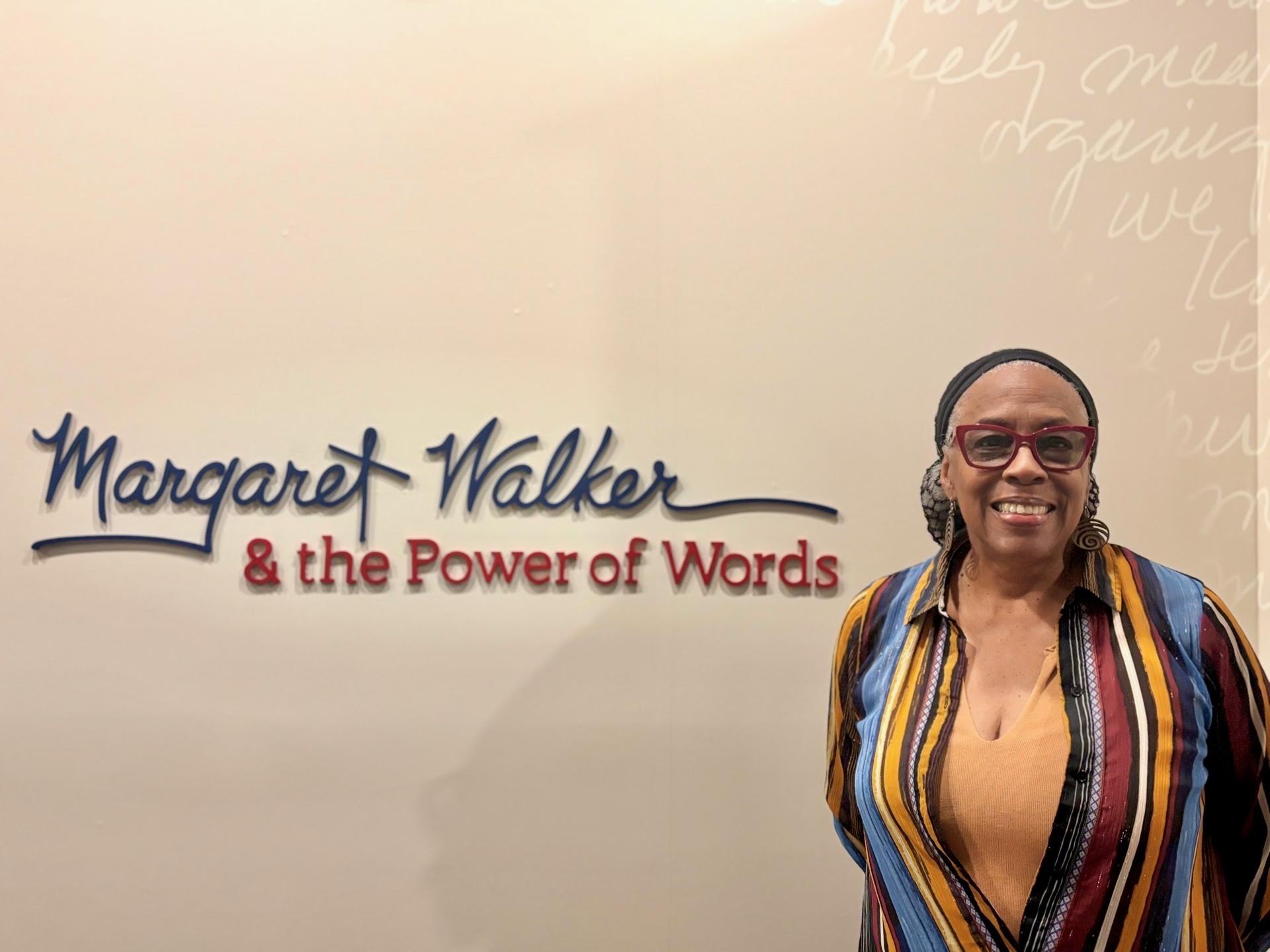
One of Jackson State University’s lasting legacies was redeveloped and relocated to fit the space of Gallery 1 for the “The Margaret Walker & the Power of Words” exhibit on Oct. 2, 2025. However, its start is a little more complicated than that.
“The Margaret Walker Center (MWC) existed first, literally just as two rooms,” said Anastasia Taylor, the History and Culture Access Consortium Director of Digital & Community Engagement at the Margaret Walker Center.
Since 1968, Margaret Walker’s legacy has remained alive on the campus of Jackson State University. However, the Ayer Hall or the Margaret Walker Center, a historic landmark on campus, is currently undergoing renovations. But Walker’s story must go on.
The Margaret Walker exhibit has been a long time coming, said Alissa Rae Funderburk, the center’s Mellon Foundation-funded oral historian.
“We’re really excited to have this event and draw people in to let them know that the exhibit is there,” stated Funderburk.
This exhibit showcases decades of work provided by Walker throughout her life. Once you enter the exhibit, you are experiencing genuine pieces of that life.
“We have everything she left. She left it in an archive, and now it’s publicly shared,” Maryemma Graham, Ph.D. With many resources at her fingertips, Graham sought to preserve Walker’s legacy.
Graham, a professor of English and African-American studies at the University of Kansas, was the event’s speaker.
Graham is the author of the comprehensive authorized biography, “The House Where My Soul Lives: The Life of Margaret Walker”, a work that explores the life and legacy of Walker. She spent decades researching and writing the biography, utilizing Walker’s personal journals and interviews with her family and colleagues to provide a nuanced portrait of the writer.
“I’m just glad that I have the chance to know her story well enough…to insert her back where she belongs,” stated Graham. And Walker had a story to tell.
Writing notable works like “For My People”, Walker became the first black woman to receive the Yale Younger Poets award in 1942. Mentored under W.E.B. Du Bois and Langston Hughes in the Federal Writers’ Project, she worked alongside like-minded writers such as Richard Wright and Gwendolyn Brooks.
“Whether it’s her published work or unpublished, they’ve never seen anything like it, so it makes her unusual,” said Graham. She was an activist who advocated for the establishment of African American studies and literature.
Walker would then go on to spend time teaching at Jackson State College, where she founded the first Institute for the Study of the History, Life, and Culture of Black People in 1968. We know it today as the Margaret Walker Center.
The exhibit received many praises on its grand opening, as many onlookers read about Walker’s life and accomplishments.
“She talks about many things that are still going on… that’s important to know to move forward,” said fellow writer Pierre Thompson.
Nyla Wansley came to support Graham, whom she had worked under as a high school student for the Project on the History of Black Writing, which Graham founded at the University of Kansas.
“It’s a piece of American history, so it’s important for her story to be put out there so that more people know about Margaret Walker and her works and what she endured as a black writer,” said Wansley, a graduate student at Tulane University majoring in public health.
Graham believes that the history and legacy of Walker should remain within the parameters of an HBCU space, as Walker intended.
“It’s (the MWC) in the community, it’s not well across some place where nobody ever goes,” said Graham.
Both students and community organizers are free to use the space.
“It’s important for us to know about our history and to read so that history does not repeat itself,” said Wansley. “Knowledge is our greatest power.”
The exhibit is open Monday through Friday, 9 a.m. to 4 p.m., and admission is free.

